Previous Page --
INDEX --
Mini Vee Race Boat Plans
Page Fourteen
Setting Up
Jack Plate
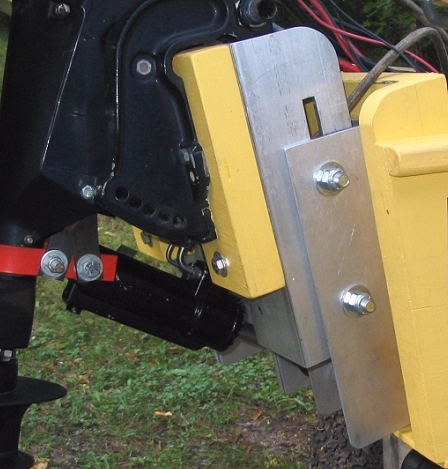
Mount your motor on a jack plate for vertical adjustment. You might want to make one from my plans. You can find the plans HERE
My jack plate is made from 4"x4" aluminum angle. Besides three inches of vertical adjustment, it also gives the engine another six inches of set-back, which is good for performance, but also makes room for a trim cylinder to be mounted between the motor board and the motor's lower unit.
Steering
Your steering system starts with a shaft and a pair of bearings. An aluminum shaft would be good lightweight choice; a stainless steel shaft will be corrosion resistant. However, all I've ever used is a 3/4" mild steel rod from the hardware store.
I get flange-type bearings from Surplus Center. Each of these bearing has two set screws so they can be locked to the steering shaft.
The exact placement of the wheel is a matter of what's comfortable to you. So climb into the boat and hold the wheel in front of you at a comfortable height.

I make my own steering drums from plywood circles. The larger circles are about six inches in diameter; the smaller ones about five inches. A large diameter drum like this makes for quick steering. My wheel rotates only a little more than a quarter turn in either direction.
Two pulley wheels are attached to the drum, bolted through with 1/4" bolts. These allow the drum to be locked to the steering shaft. 3.5" pulleys work best.
Coaming pulleys can be found at Glen L, Sorenson and Brown Tool and Machine. Also check eBay.

These steering bars are made form 1/4" x 2" aluminum bar attached at the back of the engine pan, with a brace to one of the powerhead bolts. Also, I've run my waterpump telltale hose out to the end of the bar for easier viewing.

A bend in the steering bar brings the cable attachement point almost directly opposite the hinge tube on the motor's clamp bracket. This way, as the engine is trimmed up and down, cable tension stays constant.

Trim
My trim system includes a Mercury cylinder attached to the motor and the transom with homebuilt brackets. The bracket on the transom is made from aluminum angle or channel.
A better arrangement is to have the forward end of the cylinder attached to a bracket that is part of the jack plate. This way, as you adjust the jack plate up or down, the entire cylinder moves with it, without changing the geometry of your trim system.
My jack plate plans now include this optional bracket.

The trim bracket on the motor is made from 3/16" x 1" steel bar (stainless would be better). The orange piece wraps around the bottom of the swivel bracket. The bolt at left holds this piece to the motor, while the trim cylinder is attached to bolt on the right.
Short pieces of steel extend upward from each of these bolts and are attached to a third bolt, whose head can be seen at the top of the picture.
More information about building this bracket can be found HERE.

Etc.
I use a 45 lb. deep cycle battery. There are lighter batteries around, of course, but I need the weight anyway -- minimum weight for GT Pro is 650 lbs., including boat, motor, driver and everything else. The battery hold-down is bolted through the coaming.
The battery is used for the electric start and the trim pump. Races start with the boats lined up along the beach, engines off. When the flag drops, you hit the starter and away you go. Actually, you have the option of lining up with your engine idling, in neutral, so electric start is not essential.
The fuel tank is three gallons, more than enough for a twenty-lap race. Two ratchet straps hold it down.
The Mercury trim pump, almost lost among the wires and hoses at upper right, is bolted to the transom.

Cockpit
A foot-operated throttle is required for racing, and highly recommended for the non-racer. Look for the "Hot Foot" or the "Hot Shot" or similar units. This one is a "Lead Foot." They all use the same control cable used with a hand-operated throttle/shifter.
On the right side of the dash is a Tiny Tach tachometer. On the left side is the starter button, with the kill switch (required for racing) and on/off toggle below that.
On the wheel is the trim switch and a lap counter. I have yet to remember to use the lap counter. Too busy driving the boat.
At lower left is the shifter.

Propellers
Best performance will be realized if your engine is jacked up quite high, with the prop shaft perhaps only a couple of inches below the bottom of the boat. For a prop to run at the water's surface like this, you will most likely need "cupped" blades. Cupping is little more that a short curl along the trailing edges (and sometimes the leading edges) of the blades.
Cupping can be seen on the blade at right.
New props can often be ordered cupped. Or a propeller shop should be able to cup one for you. Consider having your prop guy thin down the blades a bit as well, if he does that sort of work.
Or if you're really adventurous, you can do it yourself. I have raced both Mini GT and GT Pro with home-brewed propellers. Aluminum is easiest to work with, but stainless steel isn't as difficult as you might think.
For Mini GT racing (25hp OMC), an alumimun OMC or Michigan 10x15 propeller works very well

For GT Pro (35hp OMC), stainless 10x17 OMC props work quite well, although they have not been made for some time and may be hard to find.
Another excellent choice for your v-bottom is a chopper like the one in the photo. Mercury makes props like this, but this one came from Ron Hill in California USA. This propeller gives good bow lift and speed. I won at the OPC Nationals with this prop.
This chopper is slightly less than 10 inches diameter (a little more might be better -- 10.25" to 10.5"). Pitch is 18 inches.
See Ron Hill on ebay: stores.ebay.com/Ron-Hill-Propellers

Hit the Water!

Previous Page --
INDEX --