Fill and Sand
Fill all screw holes, gaps and other defects with epoxy mixed with micro-baloons. Some silica in the mix can help avoid a saggy filler.
Sand everything thoroughly to 100 grit at least.

Bottom Finish
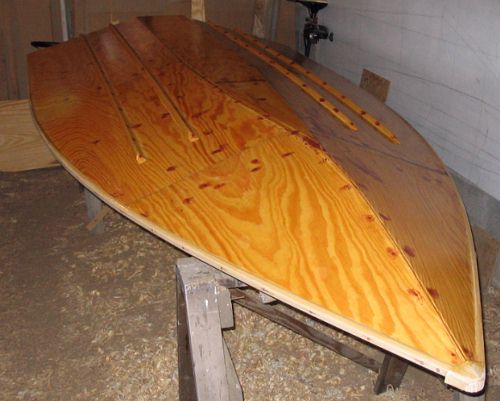
After completing the Dillon Mini, it came to my attention that plywood racing boats are typically not painted on the bottom, but are given a clear finish. It is said to be a more slippery surface.
For the Dillon Mini Vee, I finished the bottom with 4 or 5 coats of clear epoxy thickened just a little with silica. I mainly applied the epoxy with a roller, but used a 2" foam brush on the lifting strakes. Later, I sanded with a belt sander, but did not worry too much about parts of the bottom that will not typically be in the water while the boat is on plane.
It is worth noting that UV light will damage epoxy that is left exposed to the sun. This should not bother the bottom of your boat (unless it is periodically stored upside-down), but if you choose to epoxy-finish other parts -- such as the transom -- add 2 or 3 coats of UV protecting spar varnish, or just don't park it in direct sunlight.
Paint
I painted the Dillon Mini with Interlux Brightside one-part polyurethane marine paint, brushed on. It had a tendency to sag so I wasn't thrilled with the stuff.
I used Val-Spar polyurethane marine paint on the Tunnel Mite I built earlier. It had drying problems on the first coat -- took as long as 48 hours to dry.
In retrospect, the best results I have had is with Z-Spar marine enamal, which I used on a small sailboat in the early 1990s. I may very well go back to that on my next boat.
My best advice: Use a good quality marine enamel, polyurethane (one- or two-part), or epoxy. You might even try oil-based house paint. I've used latex house paint on sailboats, for what is usually called a "workboat" finish. But I don't know if you can get a smooth enough surface for a racing boat.
You can brush on your paint, or spray it on if you have the equipment. You can also choose to have your boat professionally painted, of course.
After painting, sand and wet-sand the key parts of the bottom -- or the entire bottom if desired -- to create good smooth surfaces. Remember, the boat rides on the sponson pads, particularly the aft-most 2 feet to 4 feet. The boat should not exactly ride on the tunnel plank, but it will not be riding completely dry either. So concentrate on these areas, especially from frame three to the transom.
NO WAX on the bottom -- that's the latest information I am privy to. They say that bare paint is the best surface to run on.

